The Snow® Communications Blog
Seven ways to outsmart your competition with content marketing
Posted on September 29, 2015 by Joshua Schneck


Great article in Forbes on seven ways to outsmart your competition with content marketing. Brian Sutter offers a good checklist of ways to know what your competition is doing with its content marketing, and how effective it is. With this knowledge, you can fine tune your own content marketing to stay ahead of the competition. As Sutter says:
“Most of what works or doesn’t work in content marketing is public. Because of this, it’s easy to take all of your competitors’ successes and failures and leverage them for yourself.”
Sutter shows you the tools you need to learn the following about your competition’s content marketing:
• What they publish (both on their blog and anywhere else)
• How well what they publish does on social media
• Which keywords they rank for
• What they’re doing with pay-per-click advertising, which terms they bid on, what they pay for it, and their ad copy
• Whether their social media following is growing or shrinking, and how engaged they are
• How their site performs
• Where their links are and when they got them.
Of course, your own content marketing should be well thought out, focused on target audiences, convey information that helps differentiate and position your product and company and people, and be a genuine and useful source of information to your clients and prospects. If it does all that, your blog will be well read, and Google with reward you with better placement in its search results.
Promoting vaccines
Posted on September 17, 2015 by Joshua Schneck
Attention all healthcare PR and marketing people: Let’s join together in promoting vaccines and the truth about vaccines. They save lives. Forbes contributor Tara Healle states it extremely well with “Ben Carson Doesn’t Get It: All Our Vaccines Prevent Death.”

Dr. Ben Carson during last night’s presidential debates.
What Healle finds especially disheartening is that two physicians who know better, or should know better, chose to pander during last night’s Republican presidential debate on the subject of vaccines. Dr. Ben Carson, a neurosurgeon, made the claim that while some vaccines are very important and save lives, some do not fit into this category. Carson suggested there should be some discretion in the use of these vaccines.
As Haelle points out, all of the vaccines on the CDC list for childhood vaccinations have the demonstrated potential to prevent conditions that can lead to death.
Another physician running for president, added his view. Rand Paul, an ophthamologist, said he’s all in favor of vaccines, but also in favor of freedom. Healle’s response:
“I’m for freedom too, Rand Paul. I’m for freedom from disease. I’m in favor of ensuring that my child and those in my community don’t get sick from measles and die because fear has led others in the community not to vaccinate their children.”
As a Minneapolis healthcare PR and marketing firm, we want to help get the word out. We commit to making vaccines a regular focus of this blog and will work in other ways to combat the unscientific disinformation out there about the effectiveness and safety of vaccines.
One of my good friends, a physician in Los Angeles, contracted polio as a child in the 1950’s. My friend has surmounted many difficulties, and is an inspiration to many, including myself. He is offended by untruths about vaccines. If only the polio vaccine had been around when he was a child!
Let’s not let the science doubters, including physicians running for president, carry this debate. People of reason need to speak out, loudly and often.
No competition in Medicare Advantage plans?
Posted on September 14, 2015 by Joshua Schneck

Not much competition among Medicare Advantage plans, according to The Commonwealth Fund.
Is there no competition in Medicare Advantage plans? Not according to a new study by The Commonwealth Fund. As a Minneapolis healthcare PR agency, we like competition. In the case of these privatized Medicare plans, it has the potential to drive prices down and offer more choice and better service and quality to health plan members. And, of course, as a healthcare PR and marketing firm, competition provides more opportunities for us to help get out the message.
From the abstract:
“Competition among private Medicare Advantage (MA) plans is seen by some as leading to lower premiums and expanded benefits. But how much competition exists in MA markets? Using a standard measure of market competition, our analysis finds that 97 percent of markets in U.S. counties are highly concentrated and therefore lacking in significant MA plan competition. Competition is considerably lower in rural counties than in urban ones. Even among the 100 counties with the greatest numbers of Medicare beneficiaries, 81 percent do not have competitive MA markets. Market power is concentrated among three nationwide insurance organizations in nearly two-thirds of those 100 counties.”
Is the public served by this situation? Yes, says Clare Krusing, a spokeswoman for America’s Health Insurance Plans, a Washington trade association. Quoted in The New York Times, Krusing said, “Seniors are overwhelmingly satisfied with Medicare Advantage because of the wide range of coverage options available and the overall value these plans provide. This market remains competitive, particularly with Medicare Advantage plans demonstrating improved care delivery for beneficiaries compared to traditional Medicare.”
For more on The Commonwealth Fund study, go here.
What Alice Waters can teach healthcare PR and marketing
Posted on September 10, 2015 by Joshua Schneck
Reading an old profile in The New Yorker made me think about what Alice Waters can teach healthcare PR and marketing. Alice Waters, who today won the National Humanities Medal from President Obama, opened Chez Panisse in Berkeley, California in 1971, with the idea she and her partners would provide a dining experience like that of a dinner party at home, with generosity and attention to detail, and a commitment to seasonal, local and sustainable food sourcing. While all that might seem like a commonplace in today’s restaurant scene, the fact is unmistakable that Waters started a revolution against the bland, industrial food machine that held sway at that time.
But Water’s vision is larger than a great dining experience. As the article explains, “Her vision is rooted in the romantic Berkeley politics that she practiced before starting her restaurant, Chez Panisse, with a ten-thousand-dollar loan twenty-seven years ago. She believes in concentric circles of social responsibility, with the reformed carrot in the backyard garden insensibly improving the family around the dinner table, the reformed family around the dinner table insensibly improving the small neighborhood merchants they shop with, the reformed neighborhood merchants improving their city, and so right on, ever upward and outward, but with the reformed carrot always there, the unmoved (though crisply cooked) mover in the center.”

Can you imagine people posing in front of the hospital they got care in?
What does this have to do with healthcare PR and marketing? Hospital and health plans are falling all over themselves to tell us how patient-oriented they are, how they want to hear from us, how they are committed to the whole patient and community. They are, in some cases, doing a good job of communicating. And in some cases, they are really trying to deliver. But spend time getting care for yourself or a loved one and one becomes painfully aware of the shortcomings of the system – its insensitivity to individual need, its rapacious appetite for fees, the nonexistent customer service, the often sketchy connection to the best available treatments, and yes, the appalling hospital food.
PR and marketing can aspire, but must not outrun the reality of what you are promoting. The gap is too large, and it undercuts both the message and genuine attempts to provide truly better healthcare.
What’s that? A hospital cannot be run like Chez Panisse? It would cost too much, you say? Looked at a hospital bill lately?
Did EHR miss Ebola?
Posted on September 9, 2015 by Joshua Schneck
Did an EHR miss Ebola in the case of Thomas Eric Duncan being released from a Texas hospital with Ebola-like symptoms after telling an ER nurse he had recently been in Africa? Beth Walsh, writing in CMIO, discusses a report of a panel of experts put together by Texas Health Resources, which ran a hospital that released Duncan without initially diagnosing or treating Ebola, which he later died from.
According to the report, the admitting nurse made a note of Duncan’s visit to Africa in the EHR, but her notes were not immediately visible to a physician who later examined Duncan. The report noted that processes in the emergency department “did not optimally address the early identification of Ebola or other emerging diseases during the first ED visit, nor did [the hospital] optimally utilize the full capability of the electronic health record.” Turns out that while travel history is accessible to everyone in the emergency department, to view the information, a clinician would have to look beyond the initial patient assessment screen.
Kudos to Texas Health Resources for organizing a credible panel of outside experts from prestigious academic centers and the Joint Commission to get to the bottom of what happened. From a healthcare PR perspective, Texas Health Resources has taken constructive, transparent steps to learn from the incident and help others understand how to avoid this kind of tragedy in the future.
So, did the EHR miss Ebola? The answer is both yes and no. A nurse entered a critical piece of patient history in the electronic record, but not where the physician could readily see it. Early on in the Ebola outbreak, the disease was not sufficiently on the radar screen of clinicians. In the end, an EHR cannot substitute for human wisdom.
Star Tribune featured ilos Videos
Posted on September 8, 2015 by Joshua Schneck
The Star Tribune featured ilos Videos, our client, on September 7th:
Ilos Videos, a start-up in St. Paul, looks to build on early success
By Neal St. Anthony

Nick Stokman and Sean Higgins, co-founders of ilos Videos.
Nick Stokman and Sean Higgins are a couple of 24-year-old accounting graduates of the University of St. Thomas who concluded early that they didn’t want to be accountants.
Stokman, who won an academic accounting award for his prowess while a student, recalls a painful internship at Travelers in St. Paul. He was working on corporate tax returns.
“It’s a conservative insurance company and totally different from my personality,” said Stokman, who can be irreverent and off the wall. “And I had to learn this accounting software. And clicking on the ‘help’ thing to learn this or that was totally useless. Things that can be super simple to understand can be really complicated in text.
“And I’d go to my manager, and he said that the hardest part of bringing on new people was answering the same questions.”
Stokman had an idea for a company in 2012 that, after two years of development with client companies and collaborators, launched commercial operations in January as Ilos Videos.
Ilos makes software and provides support to a growing list of 30 companies in North America and the United Kingdom who want customized videos demonstrating routine tasks such as how to put a new record in or add a personal contact into Salesforce.com, how to change account information or pay bills, or how to use the software used by ResDiary on priority seating for customers in 3,000 restaurants.
Ilos employs 12 full- and part-time employees and will post revenue under $500,000 this year, Higgins said.
“We have 20,000 users, including some free users, and people use Ilos to create short videos of ‘frequently asked questions,’ ” he said. “We make software that enables clients to communicate the things they know to employees to vendors and users of their products.
“One of our customers is Atterro [Human Capital Group]. They use ilos software for bringing on new employees. Lots of employees. And each person needs to know about timecards, expense reports, how to file for time off.”
Stokman, also a software jockey, is a self-described ADHD kid, who also was dyslexic and couldn’t read until he was 12.
He also is a genial guy who can be obsessive about work. His greatest joy, he said, is helping people, including spending weeks with his physician dad on medical-volunteer missions when he was young. Stokman was a youth entrepreneur who earned college tuition working obsessively on his own lawn service, starting when he was in high school.
And he also spearheaded a $100,000 fundraiser for a skateboard park in his hometown of Crosby, Minn. That helped settle friction between kids who wanted a place to practice and authorities who didn’t want them on private property or in the street.
“Nick is brilliant and all over the walls, the ceiling, everywhere,” said Higgins, who earned an MBA and is the calm, plain-talking face of this outfit. “He’s come to me with entrepreneurial ideas over the years. I’ve shot some down. Nick has lots of ideas. Ilos was a good one. My goal is to harness the power of Nick.”
Higgins said when Stokman told him about his idea for Ilos, he headed to Google to look for companies doing the same thing.
“We saw a lot of gaps. We didn’t see one player doing specifically what we wanted to do. It’s not YouTube, and it’s not editing software. We thought we could develop a ‘lightweight video functionality’ without big production costs in a corporate studio. But software that could enable you to communicate tasks and processes faster than anything available.”
Ilos, a Greek word Stokman and Higgins interpret as “search” as a definition, was born in their apartments.
In recent years, they would rent short-term space at cooperative-workspace Coco in downtown to impress prospective partners and clients for meetings. Several months ago the company, with revenue starting to flow, leased unfinished space in a refurbished St. Paul Lowertown warehouse. The employees work from folding chairs and tables. Frisbees and Nerf balls often sail through the air.
“We don’t have a lot of overhead,” said Higgins, including minuscule salaries so far. “We’re reinvesting in the business, and we won’t break even until next year.”
The company has raised about $500,000 in equity and is owned largely by employees, individual “angel” investors who take stakes in promising upstarts, and the Norris Institute at the University of St. Thomas. Mike Moore, who runs the Norris Institute, which invests in young, innovative concerns said Norris has a stake of about $100,000 in ilos.
Moore said he found that ilos customers “saw this as away to cut training time and reduce expenses.
“It applies to any kind of organization,” Moore said. “We have faculty who use it for courses for students they know will have problems with certain parts of the curriculum. Rather than talking them through again and again … here’s the software.”
Challenges, Opportunities in Store for ASCs in 2015
Posted on December 10, 2014 by Joshua Schneck
Challenges, Opportunities in Store for ASCs in 2015
Ambulatory Surgery Centers (ASCs) face unique opportunities and challenges among healthcare providers in the coming year. For a healthcare system focused on controlling costs and improving quality, ASCs offer a high-quality, cost-effective alternative to surgical procedures conducted in the hospital. However, ASCs face significant challenges – including a maturing market, reimbursement issues and evolving regulatory policies – that can impact their bottom lines and continue to force them to play on an uneven competitive field.
On The Bright Side
The good news for ASCs is that volume growth is expected to continue as Medicare and private payers favor the lower costs of ASCs when compared to hospitals. In an investment report issued this month by Standard & Poor’s on AmSurg Corporation, a large, publicly held operator of ASCs, S&P cited strong demand stemming from an aging population and increasing use of outpatient services. This growth outlook was echoed in a report on ASCs by Moody’s Investor Services.

ASCs face challenges and opportunities in 2015.
Medicare and Medicare beneficiaries currently share in more than $2.6 billion in annual savings for procedures performed at ASCs when compared to what those procedures would cost in the hospital outpatient department (HOPD), reports the Ambulatory Surgery Center Association (ASCA). These savings are realized in what Medicare pays for a procedure and also in lower co-pays by the beneficiaries. The ASCA notes that if just half of the eligible procedures were moved from hospital outpatient departments to ASCs, an additional $2.5 billion dollars could be saved annually.
New payment models may also come to benefit ASCs. While Moody’s expressed concern that the shift to bundled payments may not be positive for ASCs, Jameson Pearlman, VP of Managed Care at Meridian Surgical Partners, says ASCs are well positioned to participate in accountable care organizations, patient-centered medical homes and population management initiatives.
“Payers are moving more and more towards shared savings models, which are ideal for ASCs because we can better control anesthesia, implant, supply, and labor costs and still deliver high quality within a single episode of care,” says Pearlman in an interview with Becker’s ASC Review. “Bundled payments are a great opportunity for ASCs to align incentives with payers to ensure greater patient access and participation within evolving narrow networks focused on greater efficiency and accountability.”
Maturing ASC Market Means Changes
Many ASCs, especially independent ASCs, face challenges as the ASC market matures, competition increases in their market area and more hospitals open or purchase ASCs. Moody’s points out that larger players, with economies of scale and joint ventures with hospitals and physician groups, are best positioned to benefit. High performing ASCs will also be those that concentrate on procedures that generate higher revenues per treatment, such as pain management and orthopedics, according to Moody’s.
Pearlman reports excessive competition for procedure volume is depressing private reimbursement rates. “There are some ASCs in saturated markets that are accepting rates well below market and in turn payers use those lower rates as a baseline when comparing other ASCs,” says Mr. Pearlman. “Then our rates are undercut and it’s difficult to show payers why we need the higher fees to cover our expenses.”
Low reimbursement rates from Medicare are also a major issue for ASCs, even with the increase contained in Medicare’s final 2015 ASC payment rule, issued on October 31, 2014. CMS adopted an overall payment rate adjustment of 1.4 percent for ambulatory surgical centers, up from the proposed increase of 1.2 percent. But HOPDs received a larger increase, widening the gap between what Medicare pays ASCs versus HOPDs for the same procedure.
According to the ASCA, Medicare pays hospitals 81 percent more than ASCs for the same procedure. As recently as 2003 Medicare paid hospitals about 16 percent more. As a result, says the ASCA, hospitals are purchasing ASCs, converting them to hospital outpatient facilities and charging the higher outpatient rates.
On the plus side, the final rule adds 10 spine codes to the ASC-payable list and defines ASC device-intensive procedures in a way that makes it more economically feasible for ASC to offer more procedures with high device costs. However, ASCA CEO Bill Prentice notes that despite the gains there are still numerous procedures that ASCs are permitted to perform but cannot because of inadequate Medicare reimbursement for the device.
The Misfit of Meaningful Use
Another challenge for ASCs is the “50-percent rule” contained in the Meaningful Use (MU) regulations. The Health Information Technology for Economic and Clinical Health (HITECH) Act, passed as part of the American Recovery and Reinvestment Act of 2009 (PL 211-5), authorized incentive payments to eligible professionals (EP) and eligible hospitals to promote the “adoption and meaningful use of certified electronic health record technology (CEHRT).” The 50-percent rule requires that for EPs to qualify for EHR incentives, at least half of their patient encounters must be documented in a certified EHR. For ASCs, this creates a challenge since their doctors often practice at multiple locations and need to ensure that reports are sent to the location with the CEHRT.
ASCs were not included in HITECH, so many do not have certified EHRs in place because HITECH has not subsidized their purchases of EHRs as it has for physician’s offices and hospitals. This creates a potential disincentive for surgeons to bring patients to an ASC. It also seems to run counter to the stated goals of the CMS EHR Incentive Program to “improve quality, safety, efficiency, and reduce health disparities” and “to improve care coordination, and population and public health.”
ASCA is working with CMS and Congress on immediate and long-term solutions to this issue. In the meantime, since ASCs already receive lower reimbursements than hospitals for most procedures, it is very important for them to improve clinical documentation and embrace automated coding in order to receive the appropriate reimbursement. Our next ASC blog post will take a closer look at reimbursement issues specific to ASCs.
Learn strategies for maximizing revenue. Download our white paper, Positioning an ASC for the Future of Reimbursement: Best Practices for Revenue Capture.
(This post was authored by Snow for the ProVation Medical blog.)
Google Glass Pioneer Interviewed at mHealthSummit
Posted on February 5, 2014 by Joshua Schneck
Google Glass pioneer interviewed by Motley Fool. Kyle Samani, CEO of Snow client, Pristine, was interviewed at mHealthSummit by Motley Fool’s Rex Moore and Max Macaluso. In the video interview, Samani discusses his vision for improving healthcare with Google Glass applications that empower clinicians to extend their reach through telemedicine and access key information while in the OR and other clinical settings.
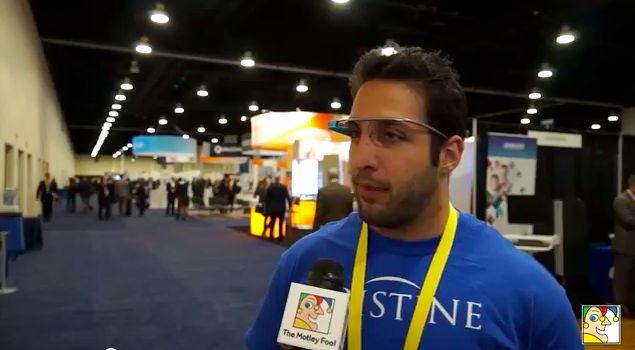
Pristine CEO Kyle Samani interviewed at mHealth Summit by Motley Fool
Pristine is delivering the next generation of telehealth communications solutions optimized for Google Glass in healthcare environments. EyeSight, Pristine’s flagship app, enables wireless, handsfree, first person, HIPAA-compliant audio/video streaming from Glass to authorized iOS devices, Android devices, Macs, and PCs. ER staff, emergency responders, and wound care staff are using EyeSight in live patient care environments today to beam in physician consults where it was never possible before. Surgeons are using EyeSight to deliver unprecedented opportunities in medical education. Other uses are being pioneered.
As a Minneapolis healthcare PR firm and content marketing firm, Snow Communications works with clients nationally to promote their business. Startups and product launches are a specialty of Snow.
Pristine was founded in Austin, Texas in 2013. More information can be found at www.pristine.io and by following @PristineIO on Twitter.
Three mistakes to avoid in healthcare government relations
Posted on January 28, 2014 by Joshua Schneck
There are three mistakes to avoid in healthcare government relations. As a Minneapolis healthcare government relations firm, we help our clients avoid these mistakes and achieve competitive advantages from understanding evolving government regulatory and statutory changes. The three mistakes to avoid in healthcare government relations are:
1. Ignore ongoing regulatory and legislative changes that might impact your business. If you’re in healthcare, government regulation is likely to impact you from any number of directions; including the FDA, Meaningful Use, HIPAA, ICD-10 (by the way, ICD-11 is being developed), Medicare rules and reimbursements, you name it. And that’s just at the Federal level. State regulations need to be watched, too, as well as the occasional oddball bill introduced at a state legislature.
A regular monitoring program that follows regulatory areas of importance to you will provide an early alert if a problem is developing and hopefully give you time to adapt or even to help stop or at least modify a pending regulation. Often, pending regulatory changes are signaled years in advance (though not always) by earlier draft regulations, Congressional hearings, think tank reports and by other means. Consistent monitoring will prevent surprises and may provide opportunities. Once the regulatory train has left the station, the chances of stopping it go down dramatically.

Chances are, there are people in government thinking about your business right now.
2. Avoid formulating a long-term strategy that identifies risks and opportunities and sets goals. The value of a comprehensive audit of pending or potential regulation is you can prioritize the most significant issues and assess not only where your interests are threatened, but where there might be an opportunity. For example, what if an agency of the Federal government is proposing a requirement that plays to a core expertise or sweet spot of yours?
In addition, effective healthcare PR and marketing communications target real pains and real needs of customers. As a Minneapolis healthcare PR agency, we look to pending government regulations as guideposts to what key buyers and decision makers will be concerned with 6-12 months or more from now. With that kind of lead time, we can make our clients the thought leaders of issues the market will be worrying about 6-12 months later.
3.Do not allocate any internal or external resources to government relations. Monitoring and creating strategy does no good if you don’t have somebody following the government for you. Many trade associations will offer monitoring and advocacy on your behalf. If you’re not a member of a trade organization that offers these services, consider joining one. But even the best trade organizations may not keep track of issues that are central to your future, and associations do not generally advocate directly for your company; they address issues common to all their members. You may well need a customized approach with resources you control. Dedicating time by an employee for government relations can make sense if you have someone on board with the knowledge, skills and interest. Another alternative is to hire an outside firm with a track record of following healthcare issues and getting good results for their client. However you do it, buy in and participation by senior management will be key.
$500 per stitch?! Three secrets of healthcare marketing
Posted on December 5, 2013 by Joshua Schneck
$500 per stitch?! That’s the average price of a stitch provided by an American hospital, according to an article in The New York Times. How do you justify $500 per stitch? Or $4,495 for a CT scan that costs $400 dollars at an outpatient facility? As a Minneapolis healthcare PR and content marketing firm, we thought about how one sells the high prices charged by American hospitals. Prices that The Times article said are going up because of consolidation of healthcare providers. Three secrets of healthcare marketing have applied over the years:
1. Avoid the subject. For years, this was the basic approach. No price transparency, no acknowledgement of price issues, no discussion. As comedian Lenny Bruce used to joke about how to handle a delicate situation (and no, I won’t go there): deny, deny, deny. An average American hospital day costs $4,000, five times the cost of a hospital stay in other developed counties, and with a la carte charges such as $36 for a single Tylenol pill with codeine (quoting the NYT article-cited prices). Avoidance and denial were fairly effective strategies, but that was before price transparency came in.
2. Make people feel sorry for the hospital. Here the hospitals are actually on higher ground, and just in time, because prices are increasingly on the web. Of the three secrets of healthcare marketing, here they have a credible case when made right. Hospital margins are dismal. Not all the patients pay their bills, Medicare reimbursements do not always meet the actual cost of providing the service, and the “list rate” is rarely the actual price paid to the hospital. Moreover, a fully-equipped and staffed hospital, ready to operate on someone’s heart on short notice, may not always cover the massive overhead at all times. Not only should you feel sorry for the hospitals, you should perhaps give to their foundation. The problem with this approach is that the hospital CEO salaries are also online.
3. Switch the subject to value delivered. Ah, this is promising and gaining speed. Borrow a leaf from marketers like Apple and BMW and move the discussion to how good the quality is and how much better the patient is for the experience. Or, take lessons from the Mayo Clinic, the Cleveland Clinic, Johns Hopkins and like masters of this. Of course, if a hospital takes this approach, they’ve got to deliver, especially since hospital outcomes and quality data are becoming increasingly available online. If fact, new rules under Obamacare and other reforms are actually starting to penalize hospitals for inferior quality and outcomes, for excessive readmissions and for hospital acquired infections. And the government is actually doing audits to detect unnecessary procedures and clawing back reimbursements for procedures the government determines are not justified by the documentation provided by the hospital.
In the end, quality may be the only answer, three secrets of healthcare marketing notwithstanding.